The Freelance Musician
The working professional.
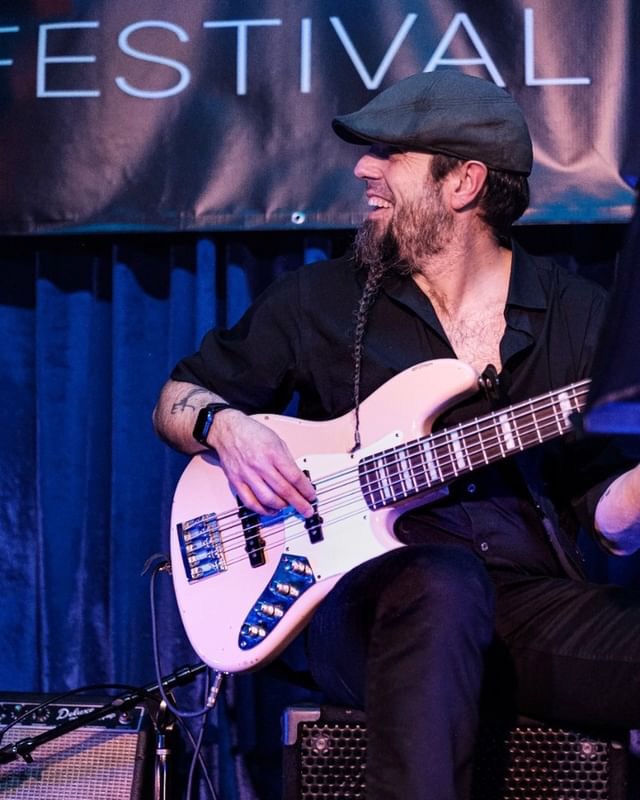
In my mind, the freelance musician is a perfect blend of the jazz musician and the pocket player. This is the path that I had latched onto pretty early in my development, primarily because I wanted to WORK. My goals were to sound like I was playing my music, no matter what music I was playing. Bossa Nova gig? Jazz gig? Funk gig? Singer-wongwriter gig? I wanted each of those band-leaders to leave feeling like I must have grown up with that music.
It may not be entirely realistic but it’s an aspiration that keeps you motivated, growing and making a living (eventually).
Stylistic awareness in abundance, active listening skills on point, great with transcription (because you are going to have to learn a million tunes), can read with the best of them, recording session ace, you’ve explored not only the notes and rhtyhms of a style of music but the tone and touch required to make it feel right. The working professional.
— sections.
It’s of the utmost importance that we develop a solid foundation. When you couple good practice with a strong foundation, we have the most efficient path towards realizing real growth on our instrument.
Click the button in order to download some helpful shape diagrams for the pentatonic, major and minor scales referenced in a few of these lessons.
A freelance musician has a deep understanding of scales, modes and chord construction. It’s a pre-requisite to meaningful improvisation over chord changes as well as a deeper level of understanding with regard to stylistic approach. We’ll dive a little deeper into this stuff later on in these lessons, but here is the more foundational side of scales and major scale harmony.
The following videos are designed to help you with both your internalization of the scale basics and how to use them but also your mindset with regard to the ‘why’ and ‘how’ of it all.
And here, we begin to explore arpeggios and, by extension, chord construction. Chords are really just scales played in 3rds (instead of 1, 2, 3, 4, 5, 6, 7, we will be stacking them in 3rds — 1, 3, 5, 7, 2, 4, 6 or 1, 3, 5, 7, 9, 11, 13, as you’ll come to think of them).
You don’t have to know how to read in order to play well (in any style). BUT… it makes everything easier. You can work through written exercises, notate your transcriptions, get WAY more gigs (the best way to learn, is to gig) and studying new styles, concepts or approaches at home in the shed is just more efficient if you can use written examples.
Here, you’ll find a few videos that I’ve done with regard to reading the basic road-maps of chord charts or lead-sheets. Beyond that, the only way to practice reading is to do it — it’s all about mental muscle memory.
Reading even 20 minutes per day will serve you FAR better than doing it in large chunks once per week. You need to build slowly and gradually on what you internalized yesterday, in order to grow. Reading notation is one of the more explicit ‘use it or lose it’ type skills.
Being a do-it-all player is as much about vocabulary as it is about time & feel. Having a deep, internal reference of grooves and approaches from those that came before goes a long way towards identifying and discovering your own approach. In order to truly understand the role and approach of a great pocket player you have to have done your homework.
Due to copyright laws, I can’t add streaming audio of my favorite tunes, but I can give you a list as a launching point and provide some public YouTube videos as a launching point.
The real pro will have enough music under their belt and in their head that, even if they don’t exactly know a tune, they’ll know it enough to give a reasonable facsimile (and will often have the ‘ears’ in shape and be able to work out the lines they can hear in their heads in real time, to a degree).
Tailor your transcriptions to your own aesthetics and genre preferences. If you want to be working pro though, don’t ignore the master song list. Bottom line, find the music you love and the players you’d like to emulate and start learning their bass lines, one note at a time.
While transcription is a fantastic way to develop your ‘ears’ (and more fun and satisfying in some ways), there are other ways to really take your development to the next level — specifically training yourself to improve upon your relative pitch, or even develop perfect pitch (yes, you can train yourself to have perfect pitch or, at the very least, much-improved relative pitch).
Sing along with your practice. Learn to really pay attention to the sounds of the intervals. Hearing a melody or bass line and singing it back is a great way to start developing pitch recognition. If you have a piano, play chords and try to identify each note of the chord with your voice. Play a basic triad and try to sing the available tensions of the chord (advanced mode!).
Harmonomics — a buddy of mine (and phenomenal versatile musician) developed an ear-training app that is a deep dive right into the serious kind of ear-training one would do at a conservatory. He uses it regularly and it shows.
Rhythm. I’ve said it before and I’ll say it again — all the right notes in the world won’t save you if it doesn’t feel good. Rhythm is a massive part of feel, of course.
You may recognize this as the ‘Rhythm Module.’ You’d be accurate.
Personally, working with rhythm like this (like a drummer) was crucial in my development of my internal time and external time-feel. I still feel like this is one of the best ways to begin your exploration of time and time-keeping (aside from just playing music with recordings and other humans, of course — NOTHING beats that, ultimately).
Tip: Take your time with each of these lessons (especially when things get a little more open to interpretation). It’s not a sprint — it’s a marathon. Slow and steady. You’ve got all the time in the world.
You may not consider yourself a ‘jazz musician’ but the working freelance player ultimately winds up playing a ton of jazz or jazz-related music. You’ve got to have the fundamentals of this style together and the most crucial part of that is your walking bass lines.
A bad bass solo is one thing, but if the walking lines or feel isn’t happening? Forget about it.
Tip: Take your time with each of these lessons (especially when things get a little more open to interpretation). It’s not a sprint — it’s a marathon. Slow and steady. Focus, listen, and let your ears guide you when your brain isn’t sure what’s ‘right.’
Let’s go a bit further in our exploration of scales, chord scales & modes.
Extensions, upper-structure triads, voice leading, substitutions. The harmonic gear that lets you play meaningfully over the chord — not just on it. For a freelance bassist, this is what separates someone who reads the chart from someone who actually plays the music.